Claim clarity
Made benefits and outcomes easier to process earlier.

Case 03 · Landing Pages · 2026
Designed to clarify the promise, sequence proof more deliberately, and improve CTA readiness.
Designed a high-converting health-supplement landing page with stronger proof placement and premium UI hierarchy.
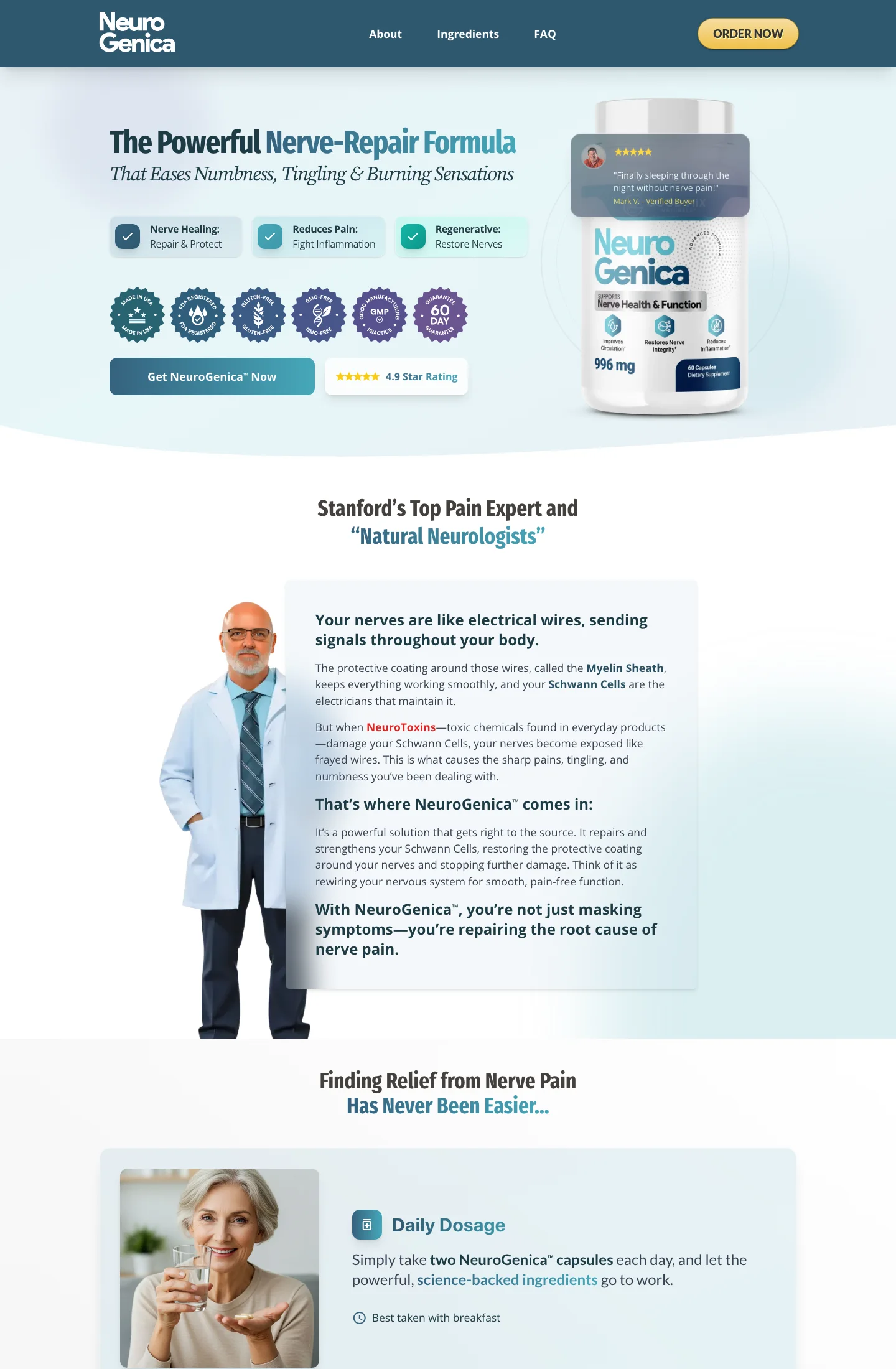
The Challenge
Users had to process claims quickly, feel enough credibility to continue, and reach the CTA without skepticism breaking the flow.
Why this matters: long-form supplement landings lose conversion power when proof is delayed or hierarchy feels generic.
Constraints (selected)
Reference links
Trust Sequence Strategy
The UX focused on improving proof placement, section rhythm, and clearer conversion anchors across the long-form read.
Designed to keep credibility building steadily instead of in isolated bursts.
Claim clarity
Made benefits and outcomes easier to process earlier.
Proof cadence
Placed stronger trust cues before major conversion asks.
Section rhythm
Used calmer pacing so users can keep moving through the page.
Conversion anchors
Made CTA moments feel more connected to the surrounding proof.
System Thinking
Why this matters: supplement landings perform better when proof and action are sequenced intentionally.
Landing strategy
The landing was restructured around a clearer proof ladder: benefit understanding first, trust reinforcement second, and action only after enough credibility had accumulated. The goal was to make the page feel more convincing without increasing content noise.
Trust Building
Helps users process the promise faster, trust it sooner, and feel more ready to act.
Clearer first-screen framing
Made the promise easier to understand early.
Cleaner proof cadence
Used reassurance where belief needs support most.
Lower-friction reading path
Reduced section noise so the story feels easier to follow.
Stronger CTA timing
Placed actions closer to the moments users are most prepared.
Why this matters: stronger trust timing is often what separates a long-form page from a convincing one.
Problem: Users should not have to decode the main promise through scattered sections.
Design action: Rebuilt the page entry and benefit ladder around faster comprehension.
Why it matters: A clearer claim reduces skepticism earlier in the flow.
Problem: CTAs underperform when they arrive before enough credibility has been established.
Design action: Moved trust cues and authority moments closer to conversion-sensitive points.
Why it matters: Users act more confidently when reassurance feels timely.
Problem: Dense sections make long pages feel harder to trust and harder to finish.
Design action: Introduced a more deliberate reading rhythm across benefits, proof, and action zones.
Why it matters: A calmer page feels easier to process and more premium.
Problem: Asking for action too abruptly increases hesitation.
Design action: Aligned CTA emphasis with the moments belief is strongest.
Why it matters: Better timing increases willingness to continue.
Decision Flow
Why this matters: users stay engaged when each section reduces doubt before the next CTA appears.
Entry
Clarified the initial claim and page entry so users understand the promise faster.
Clear entry reduces early skepticism and keeps users reading.
Value
Structured benefits and outcomes into a more readable hierarchy.
Users process value faster when the page feels ordered instead of dense.
Proof
Reinforced credibility through stronger timing of proof and authority modules.
Trust improves when reassurance arrives before users start doubting the claim.
Action
Positioned CTA moments after enough clarity and credibility had accumulated.
Action feels easier when the page has already done the work of reducing skepticism.
Expected Impact
No fake metrics. The expected impact is framed around reduced skepticism, stronger trust timing, and cleaner CTA progression.
Faster benefit understanding
Lower skepticism
Stronger credibility before CTA
Better conversion readiness
Observed business impact
Strategic improvement
Data note
Hard performance metrics were not publicly documented. Impact is described through the UX logic the landing was designed to improve: clarity, proof timing, and conversion readiness.
Related services
Next Steps
If your pages look good but still underperform, I can audit the flow, clarify the structure, and define a cleaner path before design execution.
Typical response within 24h